Hierarchy of timescales in a disordered spin-1/2 XX ladder

Jan 16, 2026·
Kadir Çeven
Kadir Çeven
,
L. Peinemann
,
F. Heidrich-Meisner
· 0 min read
What this work is about
Identified the timescales governing how a non-integrable quantum system relaxes to equilibrium, connecting spectral statistics to transport.
Abstract
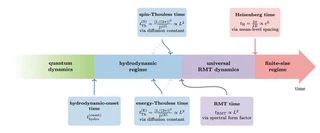
Understanding the timescales associated with relaxation to equilibrium in closed quantum many-body systems is one of the central focuses in the study of their non-equilibrium dynamics. At late times, these relaxation processes exhibit universal behavior, emerging from the inherent randomness of chaotic Hamiltonians. In this work, we investigate a disordered spin-$1/2$ XX ladder - an experimentally realizable model known for its diffusive dynamics - to explore the connection between transport properties and spectral measures derived solely from the system’s energy levels via these relaxation timescales. We begin by analyzing the spectral form factor, which yields the time when the system begins to follow the random matrix theory (RMT) statistics, known as the RMT time. We then determine the Thouless times - the average times for a local excitation to diffuse across the entire finite system - through the linear-response theory for both spin and energy transport. Our numerical results confirm that the RMT time scales quadratically with system size and upper bounds the Thouless times. Interestingly, we also find that, unlike other non-integrable models, spin diffusion proceeds faster than energy diffusion.
Type
Publication
Phys. Rev. B 113, 045126
Status
Peer-reviewed
papers
Kadir Çeven
Authors
Computational Physicist — Quantum Many-Body Systems & Scientific Software

I work on the numerical simulation of quantum many-body systems — nonequilibrium dynamics, quantum chaos, and disordered systems — using methods from exact diagonalization to neural-network quantum states. Alongside the physics, I write and maintain open-source scientific software in Julia and Python. I’m a Ph.D. candidate at the University of Göttingen.

In practice, that means building and validating exact-diagonalization codes, constructing symmetry-resolved Hilbert spaces, implementing iterative eigensolvers, and exploring neural-network quantum states as an alternative to standard variational methods — with benchmarking and reproducibility built into the process rather than treated as an afterthought.

I’m increasingly interested in applying this background to problems in quantum simulation, quantum algorithms, and scientific computing more broadly — areas where physics-informed modeling and larger-scale computation meet.

Outside of physics, I spend time with photography, travel, and cinema — particularly auteur and festival films — and I play piano, strictly as an amateur.