Neural-network quantum states for a two-leg Bose-Hubbard ladder under magnetic flux

Dec 28, 2022·
Kadir Çeven
Kadir Çeven
,
M. Ö. Oktel
,
A. Keleş
· 0 min read
What this work is about
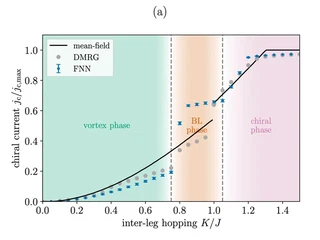
Used a neural-network variational ansatz to compute phase diagrams for interacting bosons under a synthetic magnetic flux — a gauge-field setting related to topological cold-atom physics — matching state-of-the-art numerical methods.
Abstract
Quantum gas systems are ideal analog quantum simulation platforms for tackling some of the most challenging problems in strongly correlated quantum matter. However, they also expose the urgent need for new theoretical frameworks. Simple models in one dimension, well studied with conventional methods, have received considerable recent attention as test cases for new approaches. Ladder models provide the logical next step, where established numerical methods are still reliable, but complications of higher dimensional effects like gauge fields can be introduced. In this paper, we investigate the application of the recently developed neural-network quantum states in the two-leg Bose-Hubbard ladder under strong synthetic magnetic fields. Based on the restricted Boltzmann machine and feedforward neural network, we show that variational neural networks can reliably predict the superfluid-Mott insulator phase diagram in the strong coupling limit comparable with the accuracy of the density-matrix renormalization group. In the weak coupling limit, neural networks also diagnose other many-body phenomena such as the vortex, chiral, and biased-ladder phases. Our work demonstrates that the two-leg Bose-Hubbard model with magnetic flux is an ideal test ground for future developments of neural-network quantum states.
Type
Publication
Phys. Rev. A 106, 063320
Status
Peer-reviewed
papers
Kadir Çeven
Authors
Computational Physicist — Quantum Many-Body Systems & Scientific Software

I work on the numerical simulation of quantum many-body systems — nonequilibrium dynamics, quantum chaos, and disordered systems — using methods from exact diagonalization to neural-network quantum states. Alongside the physics, I write and maintain open-source scientific software in Julia and Python. I’m a Ph.D. candidate at the University of Göttingen.

In practice, that means building and validating exact-diagonalization codes, constructing symmetry-resolved Hilbert spaces, implementing iterative eigensolvers, and exploring neural-network quantum states as an alternative to standard variational methods — with benchmarking and reproducibility built into the process rather than treated as an afterthought.

I’m increasingly interested in applying this background to problems in quantum simulation, quantum algorithms, and scientific computing more broadly — areas where physics-informed modeling and larger-scale computation meet.

Outside of physics, I spend time with photography, travel, and cinema — particularly auteur and festival films — and I play piano, strictly as an amateur.